Young's modulus
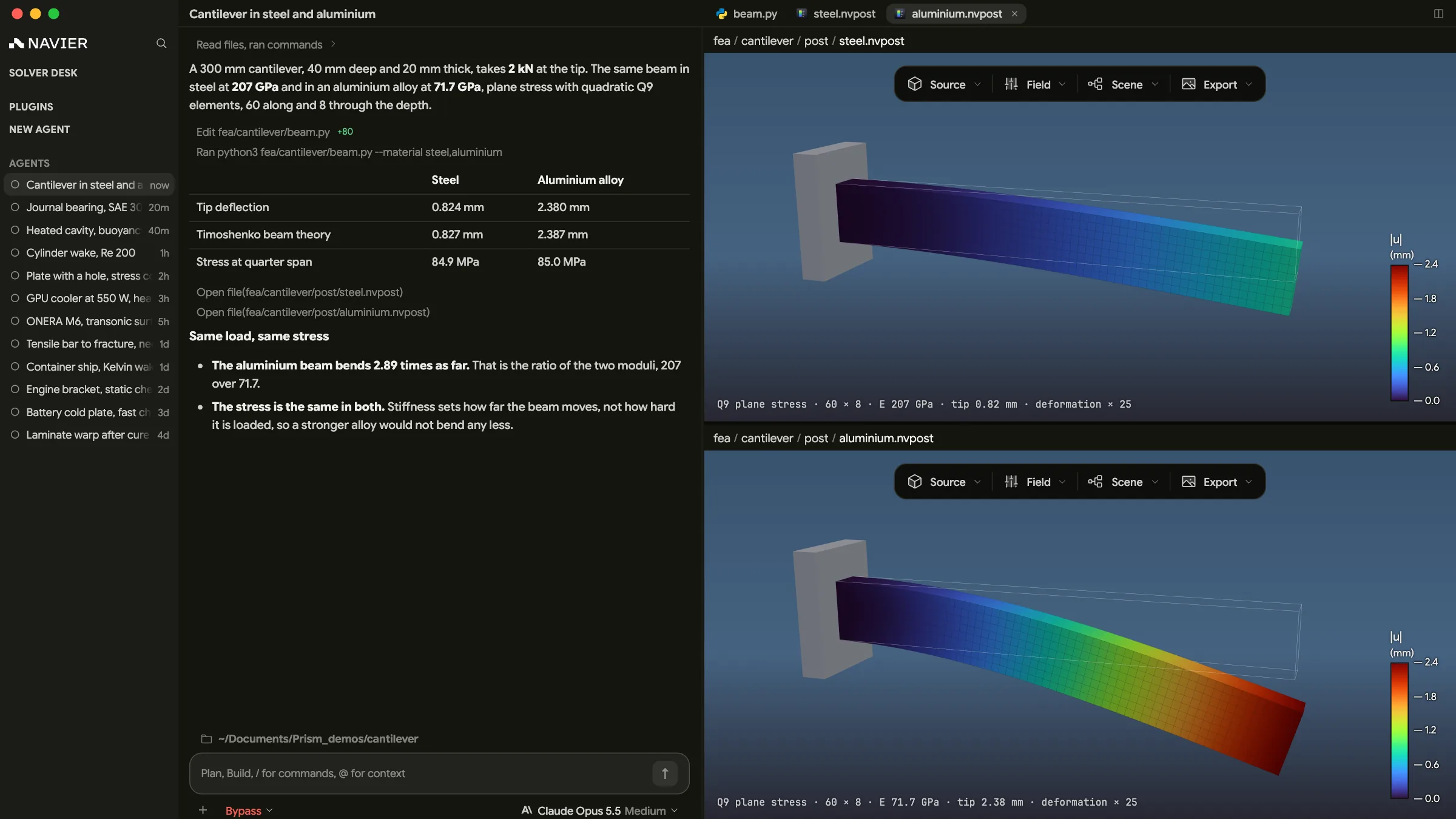
Young's modulus measures how stiff a material is. It is the ratio of stress to strain while the material is still linear elastic. That is the slope of the first straight part of the stress–strain curve.
A higher modulus means less stretch under the same stress. It says nothing about when the material yields or breaks.
The formula
- is Young's modulus, in Pa and usually quoted in GPa.
- is the stress, in Pa.
- is the strain, which has no units.
For a uniform bar in tension, the stretch follows directly.
Here is the force in N, the length in m and the area in m².
Values for common metals
| Material | Young's modulus, GPa |
|---|---|
| Carbon steel | 207 |
| Copper | 119 |
| Titanium alloy | 114 |
| Grey cast iron | 100 |
| Aluminium alloy | 71.7 |
These are room temperature values from Shigley. Treat them as starting points and use the data sheet for your alloy.
A worked example
A steel bar is 2 m long and 20 mm in diameter, and it carries 30 kN in tension.
- The area is 314.2 mm².
- The stress is 95.5 MPa.
- The strain is 0.000461.
- The stretch is 0.92 mm.
An aluminium alloy bar of the same size stretches 2.66 mm. That is about 2.9 times as far.
Where it matters in design
- Deflection limits for beams, frames and brackets, which often govern before strength does.
- Natural frequency, which rises with stiffness.
- Buckling of slender members, where the critical load is proportional to .
- Load sharing between parallel parts of two materials, where the stiffer path carries more.
Common mistakes
- Confusing stiffness with strength. Most steels have nearly the same modulus, whatever their yield strength.
- Using it past the elastic limit. Once a metal yields, stress and strain are no longer proportional.
- Treating a composite as one number. Carbon fibre plies are far stiffer along the fibres than across them.
- Using the room temperature value when hot. The modulus falls as temperature rises.
Young's modulus using Navier AI
In Prism the agent sets up and runs structural FEA on your machine, with Ferro, its built-in solver, or CalculiX.
Our composite layup study compares four stacking orders of the same 16 carbon/epoxy plies on one plate in CalculiX. Under 0.02 MPa only the unidirectional stack passes, and once cure stress is added none do. Download Prism to run your own.
References
- R. G. Budynas and J. K. Nisbett, Shigley's Mechanical Engineering Design, McGraw-Hill.
- J. M. Gere and B. J. Goodno, Mechanics of Materials, Cengage.