Viscosity
Viscosity is how strongly a fluid resists being sheared. Honey has a high viscosity and flows slowly. Air has a low one and flows easily.
It affects friction in pipes, the drag on a surface and the load a bearing can carry. It is also part of the Reynolds number.
The formula
For a Newtonian fluid, shear stress grows in line with the velocity gradient.
- is the shear stress, in Pa.
- is the dynamic viscosity, in Pa·s.
- is the velocity gradient, in 1/s.
Kinematic viscosity divides by the density , in kg/m³.
It has units of m²/s. Data sheets often use centipoise and centistokes. 1 cP is 1 mPa·s and 1 cSt is 1 mm²/s.
Values at 20 °C and 1 atm
| Fluid | Dynamic viscosity, mPa·s | Kinematic viscosity, mm²/s |
|---|---|---|
| Air | 0.0180 | 14.9 |
| Water | 1.00 | 1.00 |
| SAE 30 oil | 290 | 325 |
| Glycerin | 1,490 | 1,180 |
Air has a lower dynamic viscosity than water but a higher kinematic viscosity, because it is so much less dense.
Temperature changes these numbers a lot. Liquids get thinner as they warm. Water at 80 °C is about a third as viscous as at 20 °C. Gases do the opposite.
A worked example
A plate with an area of 0.1 m² slides at 2 m/s over a 1 mm film of SAE 30 oil at 20 °C. The flow is laminar, so the velocity changes linearly across the film.
- The velocity gradient is 2,000 per second.
- The shear stress is 580 Pa.
- The drag force is 58 N.
With water in the same gap, the force would be 0.2 N if the flow stayed laminar.
Where it matters in design
- Pipe and duct losses, through the Reynolds number and the friction factor.
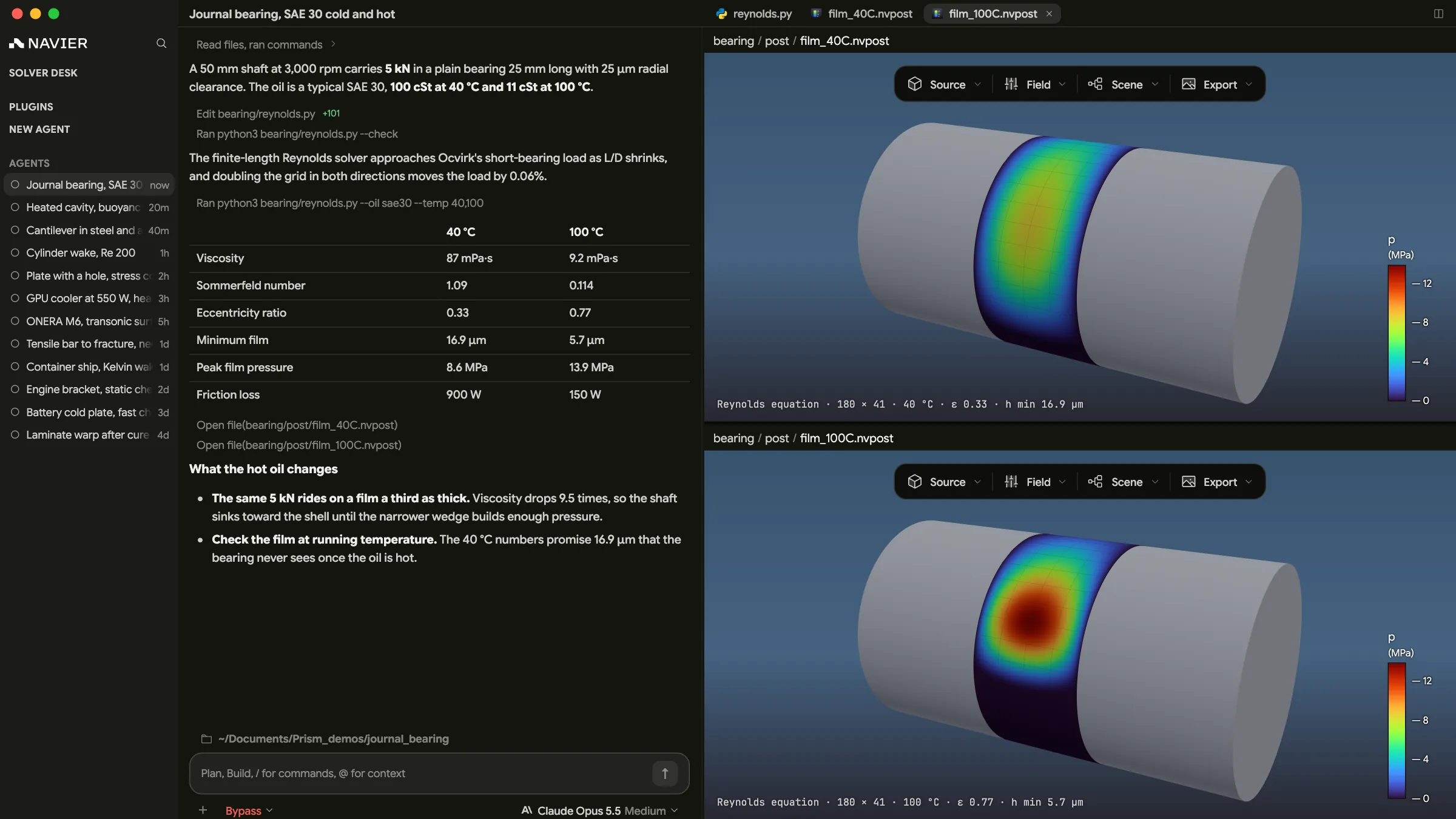
- Bearings and lubrication, where film thickness depends on viscosity at running temperature.
- Pump sizing for oils and other thick fluids.
- Wall shear stress, which decides whether settled solids move and affects how fast some surfaces erode.
Common mistakes
- Mixing up dynamic and kinematic viscosity. Check the units before using a value.
- Using the 20 °C value at running temperature. Oil can thin by an order of magnitude when hot.
- Assuming a fluid is Newtonian. Paint, blood and slurries change viscosity with shear rate.
Viscosity using Navier AI
In Prism the agent sets up and runs established solvers such as OpenFOAM on your machine.
Our tank sludge study uses wall shear stress to find how much of a tank floor stays clear of settled sludge. Radial jets leave 90% of the floor below an assumed 1.5 Pa threshold for moving sludge, and jets turned 53° leave 62%. Download Prism to run your own.
References
- F. M. White, Fluid Mechanics, McGraw-Hill.
- B. R. Munson et al., Fundamentals of Fluid Mechanics, Wiley.