Buoyancy
Buoyancy is the upward force a fluid puts on an object in it. It equals the weight of the fluid the object pushes aside, which is Archimedes' principle.
The force comes from pressure, which rises with depth. The bottom of an object is pushed up harder than the top is pushed down.
The formula
- is the buoyant force, in N.
- is the density of the fluid, in kg/m³.
- is gravity, 9.81 m/s².
- is the submerged volume, in m³.
An object floats when the buoyant force can match its weight before it is fully submerged.
Force per litre displaced
| Fluid at about 20 °C and 1 atm | Density, kg/m³ | Force per litre, N |
|---|---|---|
| Air | 1.205 | 0.0118 |
| SAE 30 oil | 891 | 8.74 |
| Fresh water | 998 | 9.79 |
| Sea water | 1,025 | 10.06 |
A worked example
A sealed float has a volume of 0.5 m³ and a mass of 120 kg. How much can it carry in sea water?
- Fully submerged, the buoyant force is 5.03 kN.
- Its own weight is 1.18 kN.
- The net upward force is 3.85 kN. That holds up a payload of 392.5 kg.
Any dry payload above that sinks it.
Buoyancy in heat and air flow
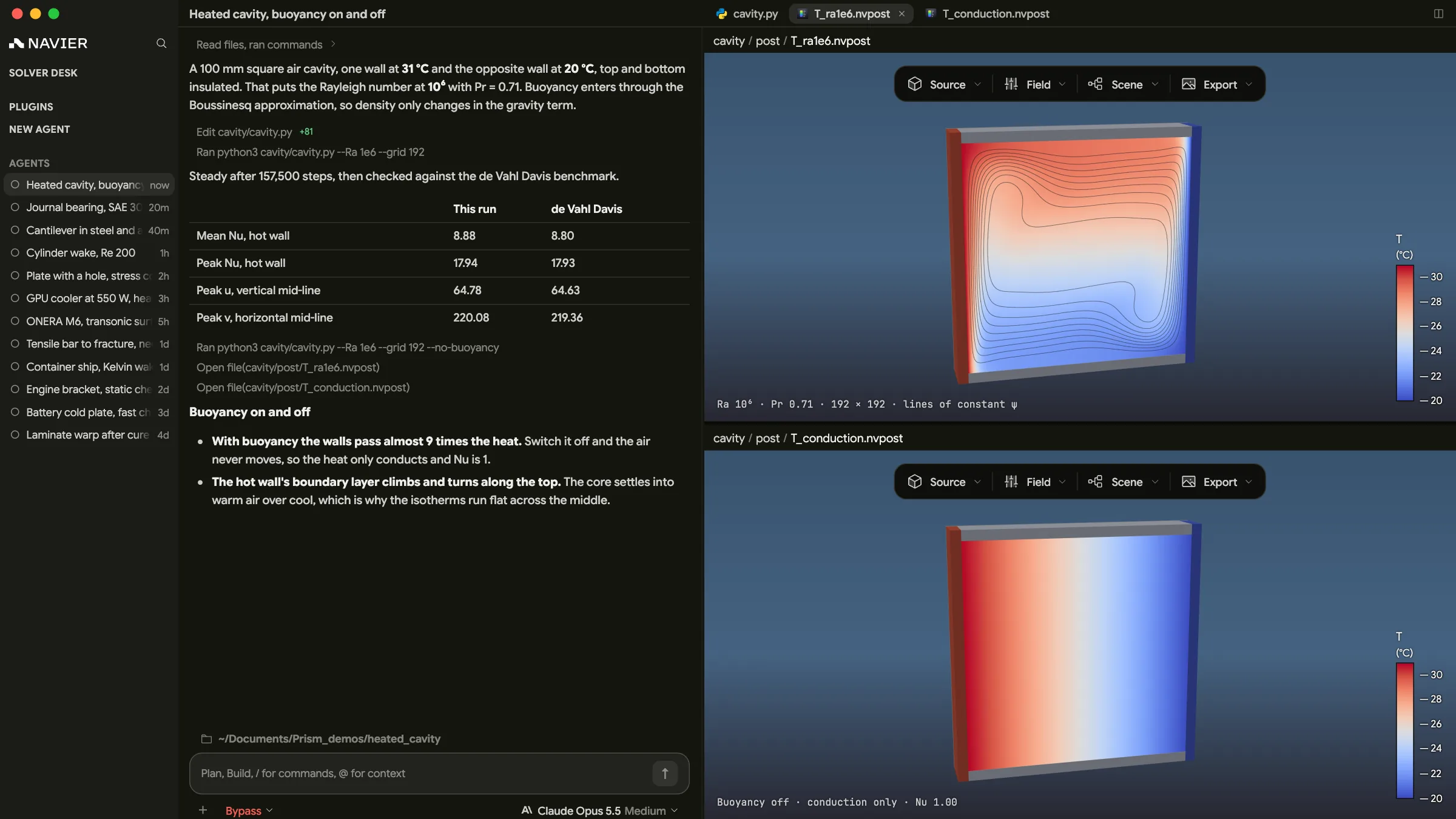
Warm fluid is lighter than the cold fluid around it, so it rises. For small temperature differences, the density change is close to linear.
Here is the volumetric thermal expansion coefficient, in 1/K, is the reference density and is the temperature difference, in K.
Simulations use this in the gravity term only and treat density as constant everywhere else. This is the Boussinesq approximation.
Where it matters in design
- Natural convection, which cools electronics with no fan.
- Stack ventilation, where warm air leaves through high openings.
- Stratified tanks, where warm water sits on cold water and resists mixing.
- Floats, hulls and subsea equipment, where stability depends on where the centres of buoyancy and gravity sit.
Common mistakes
- Using the object's density where the fluid's density belongs.
- Using the full volume of an object that is only partly submerged.
- Leaving buoyancy out of a thermal simulation when flow speeds are low.
- Using the Boussinesq approximation for large temperature differences. It holds only while is much less than 1.
Buoyancy using Navier AI
In Prism the agent sets up and runs established solvers such as OpenFOAM on your machine.
Our tank mixing study uses the Boussinesq approximation to model jets mixing a stratified 246,727-gallon water tank. Our natural ventilation study finds roof vents 4.5 m above the windows make a house's still days about as cool as its breezy ones. Download Prism to run your own.
References
- F. M. White, Fluid Mechanics, McGraw-Hill.
- F. P. Incropera et al., Fundamentals of Heat and Mass Transfer, Wiley.